
How to Train for a Race With a Friend (and Actually Finish It Together)
Share the week, not the plan.
The race is the commitment device, not the plan
Training for a race alone is a plan. Training for a race with a friend is a commitment device. The difference matters, because most people do not quit race training in the middle of week nine. They quit in week one, before the training ever starts, because there was no date on the calendar and no person expecting them at the starting line.
Pick the race first, together. Not "sometime in the spring." A specific event with a registration page, an entry fee, and a start time. Atlanta has a good menu to choose from: the AJC Peachtree Road Race every July 4th if you want the classic 10K, the Publix Atlanta Marathon weekend in February if you are going long, and a steady rotation of 5Ks and half marathons across the fall that double as lower-stakes first targets. Once you both have your bib confirmation in your inbox, every awkward conversation about skipping a training run is now a conversation about wasting money and letting someone down. That is exactly the kind of social friction you want working for you.
Register on the same day. There is a real, documented dropoff between "we should do this" and "I signed up," and the pair that signs up together in one sitting removes the whole failure mode where one person registers, waits, and eventually stops waiting.
Stop trying to follow one plan
This is where most training pairs fall apart. You are not the same runner, and a plan that fits both of you perfectly will fit neither of you well. One of you runs 15 miles a week and the other runs 30. One of you has done a half marathon before and the other thinks a 5K is the whole plan. Forcing one PDF onto two different runners turns training into a resentment generator: someone is always sandbagging, someone is always drowning, and both of you feel like the problem.
Instead, share the week, not the plan. Keep two individual plans and overlap the sessions that work best together. The rule of thumb: share the long run and one workout day, do the rest solo. Long runs are conversational by nature and they are the sessions that most benefit from company. One shared workout a week, like hill repeats or an interval session on a track, gives you a mid-week appointment to anchor around. Everything else can stay personal. This is how two runners at genuinely different fitness levels train "together" without one of them running 90 seconds per mile slower than they need to.
For the different-pace problem specifically: run the warm-up and cool-down together, split the middle. On a 10-mile long run, the faster runner can do a solo mile on either end and the shared eight in the middle. On intervals, same track, same rest times, different paces. You were never required to run side by side every step to count as training partners.
Set the shared calendar on day one
A plan that lives in one person's head is a plan that dies in one person's head. Before week one, sit down together (or text it out) and lock the shared sessions for the entire training block: which mornings, which route, how long each long run gets. Put every shared run on both calendars as a real event with a start time, not a vague "Saturday morning run?"
Then agree on the miss rule in advance, because someone will miss one. A good miss rule: one solo make-up run is fine, two missed shared sessions in a row triggers a check-in, and neither of you ever silently ghosts a run. The check-in is not a fight, it is a phone call that asks "are you still in?" People quit races by disappearing, not by deciding. A standing agreement to call it out keeps disappearance from being the default exit.
Race week: align on the goal, not the time
The last two weeks before the race are where friendship stakes get weird. One of you wants a PR, the other just wants to finish, and if you never say it out loud you will both spend race morning projecting. So say it out loud: what does a successful race day look like for each of you?
If the goals differ, decide the plan. Two honest options: start together, run your own races, and meet at the finish line. Or agree that the goal is finishing side by side, and the faster runner accepts that as the day's mission. Both are completely valid. What does not work is the faster runner pretending to run easy and getting quietly furious at mile 22, or the slower runner pushing past their plan to keep up and blowing up at mile 15. Name it beforehand and the finish line is a celebration instead of a debrief.
What to use to keep it together
The training plan can come from anywhere: a free Hal Higdon-style program, your running club's coach, a book you both own. The hard part is not the plan, it is the shared logistics. You need a place where the training block lives that both of you see, where the shared sessions get scheduled and confirmed, and where going quiet gets noticed before it becomes quitting.
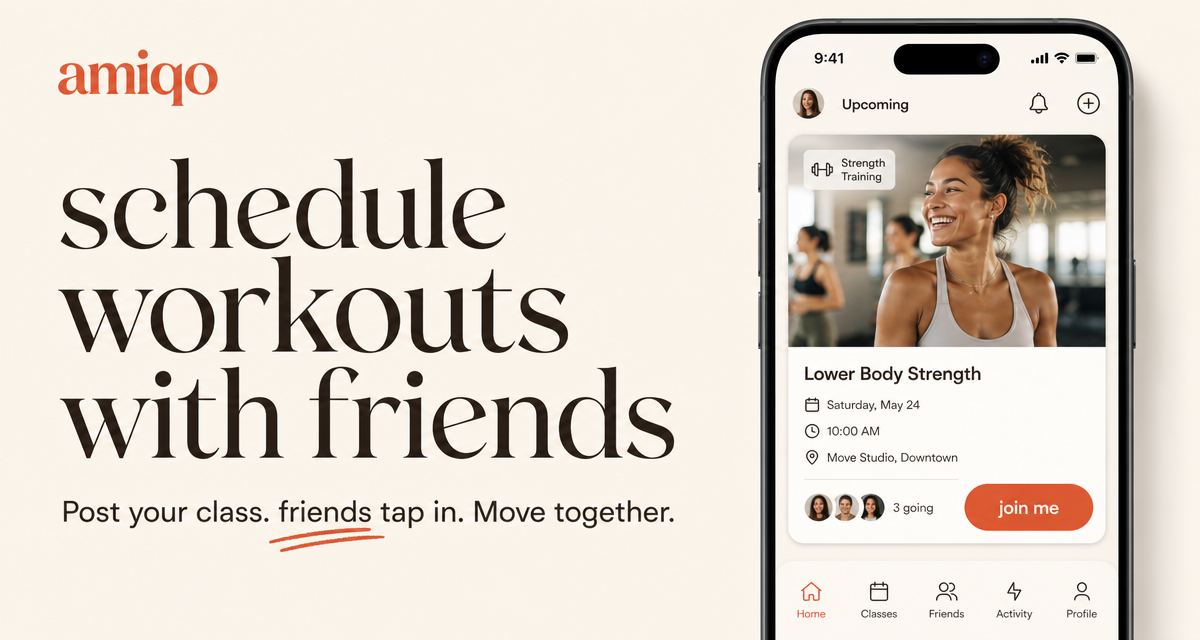
That is the problem amiqo was built for. It is a fitness app for friends you already have: you plan the workouts together, you see the sessions on a shared calendar, and it notices when a training partner goes quiet and helps you reach out in your own voice. It will not write your training plan for you, and it will not pretend your race is listed somewhere it is not. It just makes sure the friendship part of race training keeps working, because the friendship is what gets you to the start line.
Try this with your group this week
This week, turn one good intention into a plan. Post the workout, let friends tap in.
Free to download. Available on iOS and Android.