
Workout Accountability With Friends: Why the Group Chat Always Fails
The group chat was supposed to keep you accountable. Instead it became 400 unread messages and zero workouts. Here is why it fails, and the simple system that replaces it.
Short answer: workout accountability with friends works when the plan has a specific time, a visible headcount, and a yes that takes one tap. Group chats fail because they turn one clear commitment into an endless conversation.
The anatomy of a dead fitness thread
It starts the same way every time. Someone creates a group chat, names it something optimistic like "summer shred," and everyone is enthusiastic for exactly four days.
Then the pattern sets in. One person suggests Tuesday. Someone else counters with Thursday. A third person sends a meme. The plan dissolves into 400 unread messages, three competing polls, and zero workouts. Two weeks later someone types "we still doing this?" into the void. Nobody answers.
The group chat did not fail because your friends are lazy. It failed because a group chat is a conversation tool doing a coordination job.
Why "sometime" is not a plan
Almost every dead thread dies at the same sentence: "we should work out sometime."
"Sometime" is not a plan. It is a wish with witnesses. Nobody can put "sometime" on a calendar. Nobody can show up to "sometime." And because nobody committed to anything specific, nobody feels accountable to anything specific. The vagueness is the whole problem, and the group chat makes vagueness easy. Every message is another chance to defer the decision.
Real accountability needs three things the group chat cannot provide: a specific time, a visible headcount, and a yes that takes one tap instead of twelve messages.
For the broader planning system, see how to schedule workouts with friends.
What actually keeps friends accountable
Forget motivation. The research is consistent on this: you do not need more willpower, you need a better system. The crews that keep showing up share four traits.
One specific invite, not a question. "Gym Saturday 9am, I'm going" beats "does anyone want to work out this weekend?" every time. Announce instead of asking. Questions invite negotiation. Announcements invite a yes.
One standing slot. The crews that last protect the same time every week. Saturday 9am is a ritual. "Whenever works" is a rumor. When the slot is fixed, skipping feels like missing something instead of just being busy.
A visible headcount. People show up when they know specific humans are expecting them. "Three friends are going" is accountability. A read receipt on a group message is nothing.
A yes that costs nothing. Every extra step between the invite and the commitment loses people. If saying yes requires downloading an app, making an account, and joining a challenge, you have already lost the two busiest friends. One tap is the whole budget.
If you are building a recurring crew, the next step is running the workout group without becoming its unpaid organizer.
The system that replaces the thread
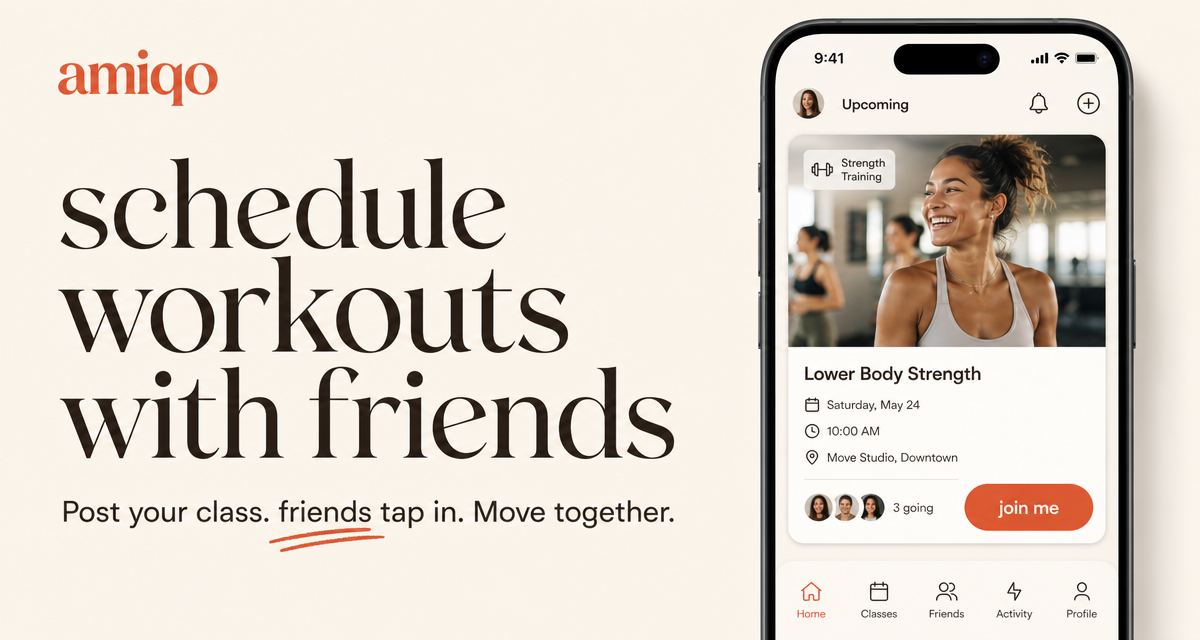
Here is the entire playbook. Post what you are doing, with the time and place. Your friends tap in. You see exactly who is coming. That is it.
No polls. No "does Thursday work for everyone?" No scrolling back through 200 messages to find the address. One post does the organizing the group chat was failing at, and the thread goes back to what it is good at: memes and post-workout photos.
This is what amiqo is built for. You post the class, run, or gym session you are headed to. Your friends tap "I'm in." You get a headcount before you leave the house, and after the workout you rate the class so your crew knows where to go next. No feed, no followers, no performance. Just your circle, showing up.
It also quietly keeps track of who you went with, and nudges you when a friend has gone quiet, with the words to reach out. Because the real threat to a workout crew is not one bad week. It is the slow fade nobody mentions until the crew is gone.
Download amiqo free and post the next workout while the plan is still fresh.
What about the friend who still flakes?
Every crew has one. The system does not fix them, and that is fine. What it does is make the flaking visible and cheap. When the headcount is public to the circle, most people show up more. And when someone quietly drops off three weeks in a row, you notice in time to send one real message instead of discovering it two months later.
Accountability was never about pressure. It is about making the commitment visible enough that keeping it feels natural.
For a one-to-one version of the system, read how to find a workout accountability partner.
Kill the thread, keep the friends
The group chat is not the enemy. It is just the wrong tool. Keep it for the jokes. Move the plan somewhere built for plans.
Post the workout. Your friends tap in. Sometime becomes Saturday at 9.
FAQ
Why do workout accountability group chats fail?
A group chat is a conversation tool doing a coordination job. Plans stay vague, every reply reopens the decision, and nobody commits to a specific time or visible headcount.
What keeps friends accountable for workouts?
Use one specific invite, one standing weekly slot, a visible headcount, and a yes that takes one tap. These make the commitment clear without adding pressure.
Should you poll friends about workout times?
Announcing a specific plan usually works better than opening another poll. A clear day, time, and place gives each friend one easy decision instead of another negotiation.
How does amiqo help with workout accountability?
You post the class, run, or gym session you are attending. Friends tap in, everyone sees the headcount, and the plan stays visible outside the group-chat thread.
What should you do when a workout friend keeps flaking?
Make commitments visible without adding pressure. If someone drops off for several weeks, notice early and send one real message rather than letting the friendship quietly fade.
Try this with your group this week
Post the session you already planned this week and let your people tap in.
Consistency is a people problem, not a willpower problem.