
Strength training with a friend: how to start lifting together at different levels (2026)
Share the session, split the load, and keep score only against yourself.
The real reason most lifting partnerships never start
You want to lift with a friend. Your friend wants to lift with you. And then neither of you starts, because one of you can deadlift twice what the other can, and that feels like a problem before you have even picked up a bar.
It is not a problem. It is the normal shape of training with a friend, and it is also the reason it works so well. The stronger lifter gets a training partner who shows up. The newer lifter gets someone who knows the gym and makes the first month much less awkward. Different levels are not a mismatch. They are the deal.
The partnerships that fail are not the ones with a strength gap. They are the ones where nobody agreed on how the session would actually work, so one person ends up waiting around, the other ends up feeling judged, and both quietly stop suggesting it.
Share the session, not the weights
The mistake is trying to do the same workout at the same weight. That turns a shared session into a competition or a coaching lesson, and neither one is fun for long.
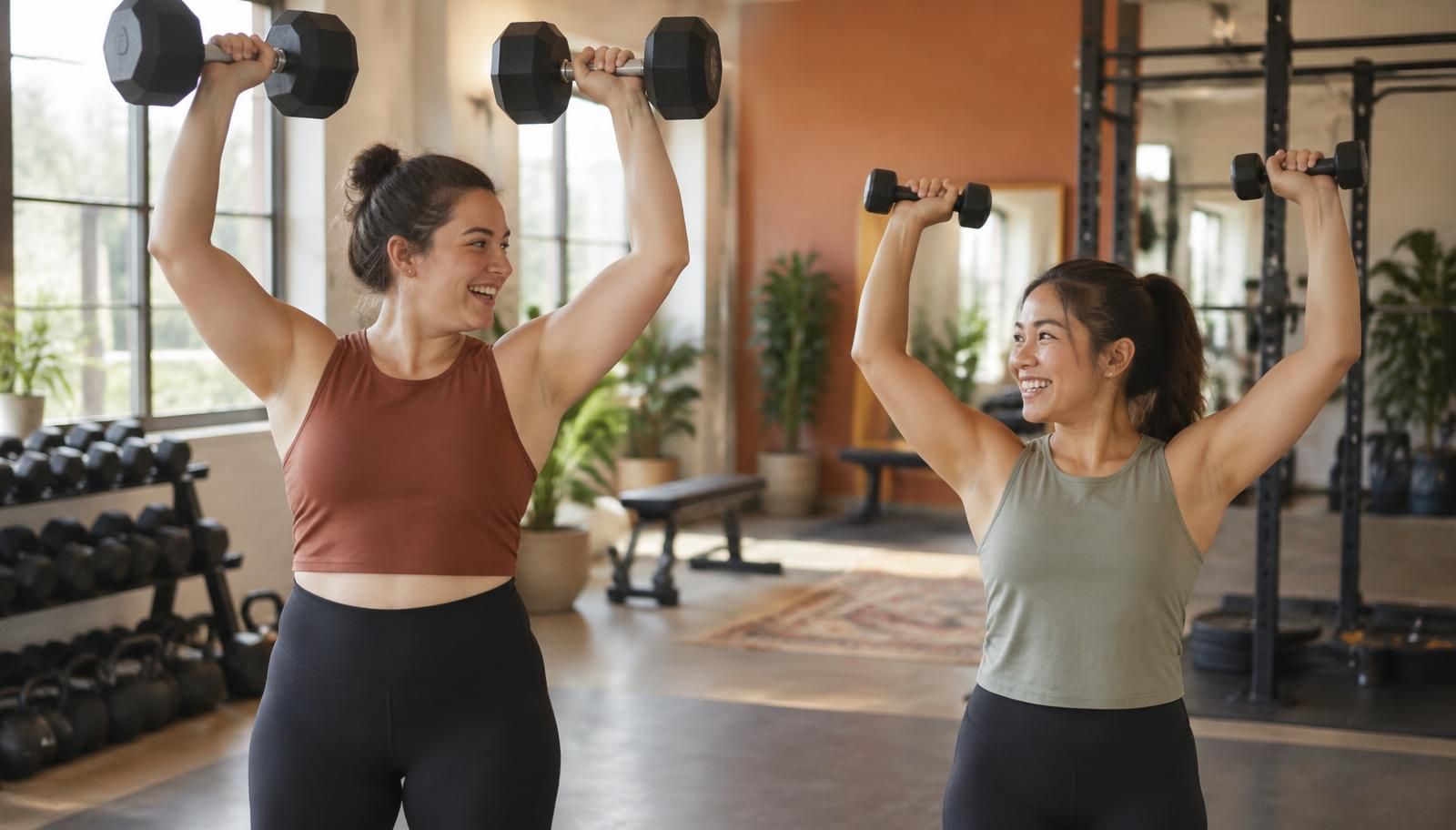
Instead, share the structure and split the load. Same exercises, same order, same rest periods, different weights. You both squat. You both press. You both row. The bar or the dumbbells just weigh different amounts, and nobody cares, because the session is the shared thing, not the number on the plate.
Dumbbells make this easy. Two people can stand side by side, grab different weights, and do the exact same set at the exact same time. Machines work the same way, since changing the pin takes five seconds. Barbell work takes a little more planning, because changing plates between sets slows things down, so save the barbell lifts for the first exercise when you are both fresh, and use dumbbells and machines for the rest.
Use formats that scale to both of you
Some session formats handle a strength gap better than others, and picking one of them up front removes most of the friction.
You-go-I-go sets are the simplest. One person does a set while the other rests, then you swap. The rest period is built in, nobody waits around, and you can each use your own weight without touching the plates in between. It works for almost every lift.
Supersets work well too. Pair two exercises and move between them together, each at your own weight. The pace stays up, the session feels like a shared effort, and the strength difference never comes up because you are both busy.
Circuits are the most forgiving format of all. Set up four or five stations, do 40 seconds at each, and rotate. A circuit does not care how much you lift. It cares that you both keep moving, and it ends with both of you tired in the same way, which is the feeling that makes people come back.
Spot each other, coach less
A good lifting partner spots. A bad one coaches every rep. That distinction matters more when the levels are different, because the stronger lifter will be tempted to fix the newer lifter's form on every set, and the newer lifter will stop enjoying the session fast.

Spot the heavy sets, hand off the bar when it helps, and count reps out loud if your partner likes that. Then stop. Unless something is unsafe, save the form notes for after the session, and keep them to one thing at a time. Most people learn faster from a relaxed session they repeat than from a perfect session they dread.
If your friend asks for help, give it gladly. If they do not ask, assume they are learning by doing, just like you did.
Agree on the plan before you walk in
The single most useful conversation happens before the first session, and it takes about two minutes. Agree on three things: which days you train, how long the session lasts, and what happens when one of you cannot make it.
A standing slot does the heavy lifting here. Same two days a week, same time, same gym. When the plan is fixed, neither of you has to renegotiate it every week, and the session survives busy periods because it is just what you do on Tuesdays.
For the full setup, read how to schedule workouts with friends (and get them to show up).
Decide the no-show rule too. The session still happens if one of you cancels. The person who shows up trains solo that day, no guilt, no rescheduling spiral. That rule protects the habit and the friendship at the same time.
Track progress separately, celebrate together
The fastest way to kill a lifting partnership is to compare numbers. One of you will always be ahead on something, and the scoreboard turns a shared habit into a quiet contest.
Track your own progress. Write down your weights, your reps, and the date. Watch your own numbers move week to week, because that is the progress that matters. Then celebrate the shared milestones instead: the month you both showed up eight times, the first session your friend did without needing a spot, the day you both added weight to the same lift in the same week.
Progress you can see is what keeps people training. Progress you can share is what keeps people training together.
Start this week, not next month
You do not need matching strength, matching schedules, or a perfect program. You need one friend, one gym, and one standing slot. Pick two days, agree on a simple full body session, and go. The first session will be a little clumsy. The second one will be smoother. By the fourth, it will feel like the thing you do, and that is when it sticks.
If you are restarting after time off, the same rule applies. Start light, start together, and let the habit build before the weights do. Read how to get back into working out with a friend for the restart plan.
Get your lifting crew in one place
The hardest part of lifting with a friend is not the workout. It is getting the plan out of the group chat and onto a calendar. Post the session, let your friend tap in, and you both know it is happening before you leave the house.
Download amiqo free: https://amiqo.life/download
Plan your next lift with a friend. Post the session, your friend taps in, and Tuesday becomes the day you lift.
Try this with your group this week
Post your next session this week and let one friend tap in.
One post, one tap, one fewer cancelled workout.